plastic bottle sourcing guide
plastic bottle sourcing guide: avoid these 3 traps
2026-08-01
bottle caps
why are bottle caps not made of PET?
2026-08-15

Plastic Bottles/Fibre: The Complete PET Recycling Pathway

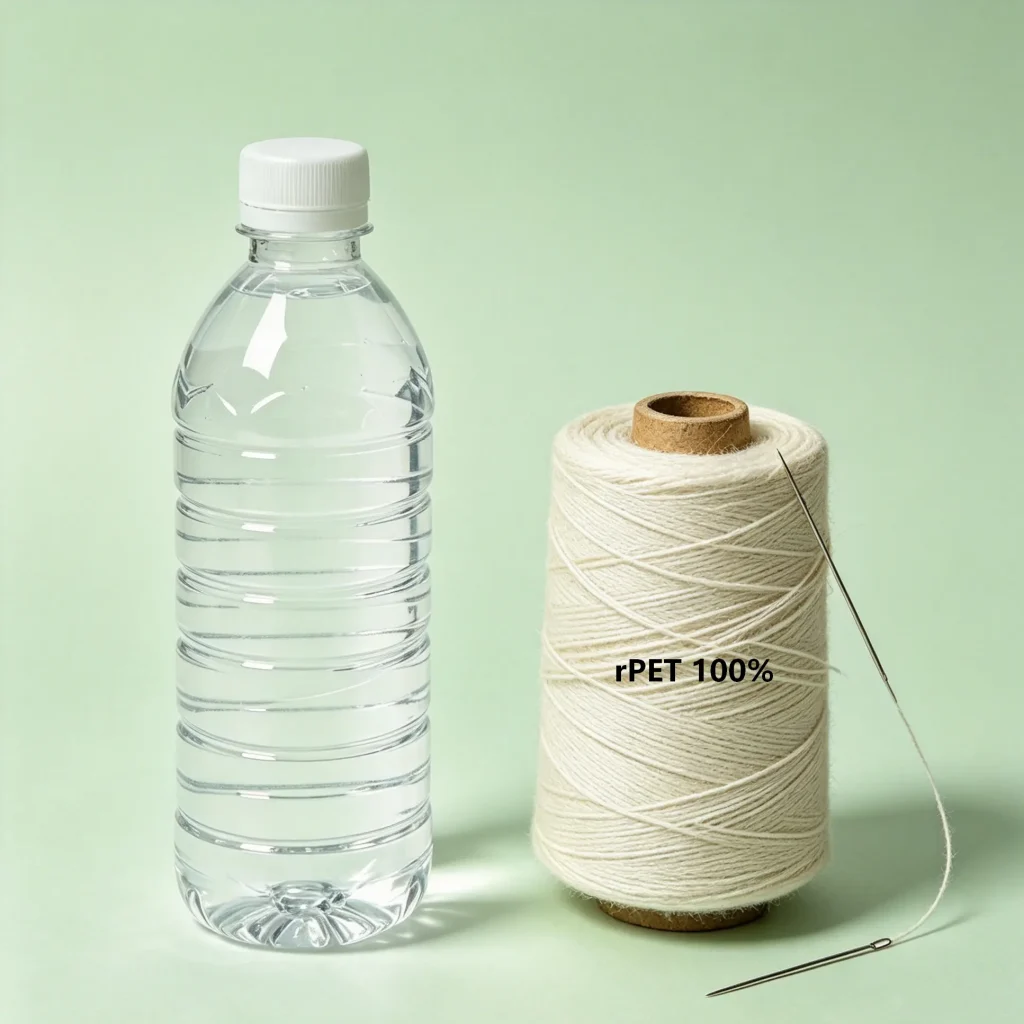
Have you ever wondered what happens to a plastic bottle after you toss it into the recycling bin? As a PET bottle manufacturer, we fully recognise the immense potential of this material. Today, we invite you to explore the complete journey of PET recycling.

One material--Two different forms

Pick up any mineral water bottle and turn it over. At the bottom, you’ll find the triangular recycling symbol with the number “1” – that’s polyethylene terephthalate (PET). This material isn’t just for bottles; it’s also the main ingredient in the polyester clothing hanging in your wardrobe.

Though their forms differ, their molecular structures are identical. The key indicator for measuring PET’s molecular weight is intrinsic viscosity (IV):

          · Bottle-grade PET: IV typically around 0.80 dL/g.

          · Fibre-grade PET: Ranges from 0.64 dL/g (general textiles) to 0.85–1.0 dL/g (industrial yarns).

Higher molecular weight means longer chains, more entanglements, and stronger fibres when drawn.

From waste bottles to clean flakes

Turning a used PET bottle back into clean raw material involves a complete pre-treatment process:

          · Sorting: PET bottles are separated from other plastics. Non-PET components like caps (usually HDPE or PP) and labels (PVC or paper) are removed – these account for about 20–22% of the total bottle weight.

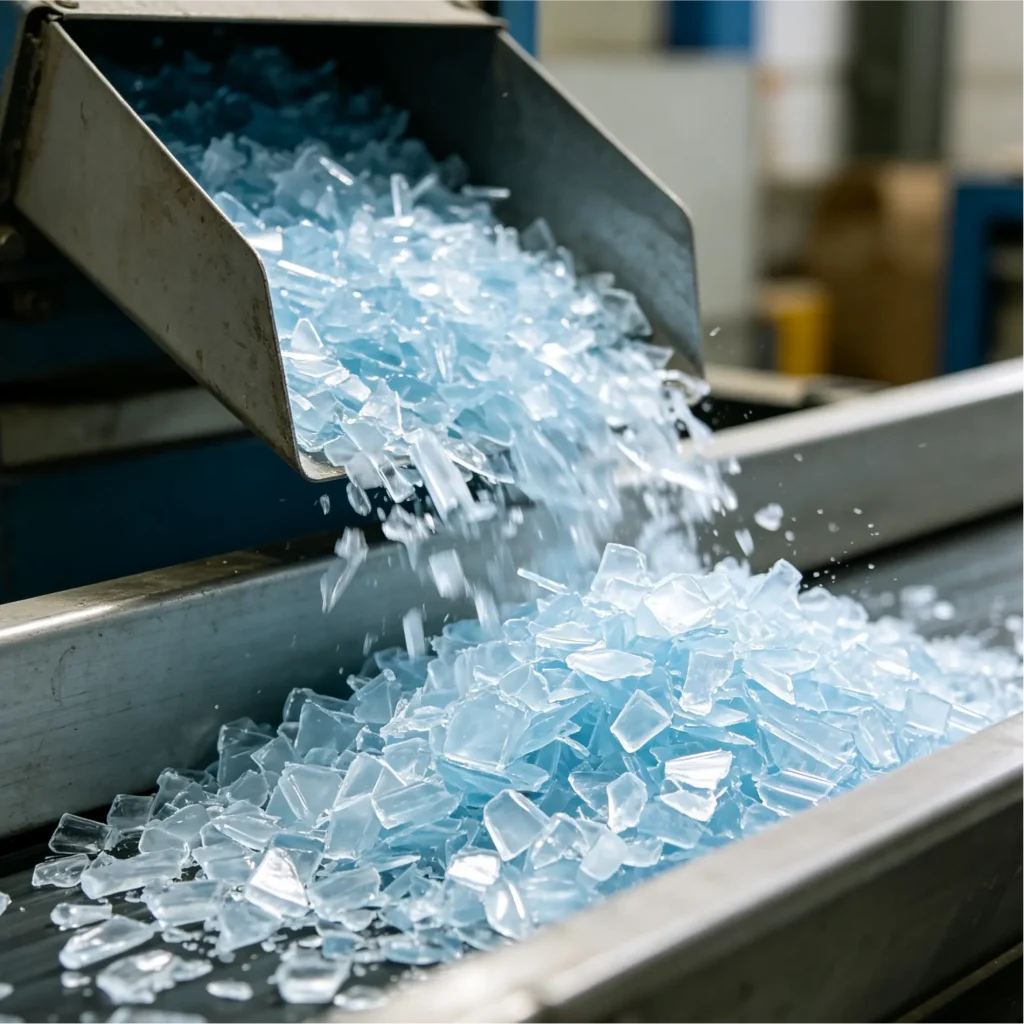
          · Grinding: Clean bottles are ground into flakes of 6–14 mm in size, known in the industry as “flake.”

          · Washing & Separation: Hot alkaline solutions and friction washing remove label adhesives, residual beverages, and dirt.

After these steps, clean PET flakes are ready for the next stage of their journey.
PET recycling

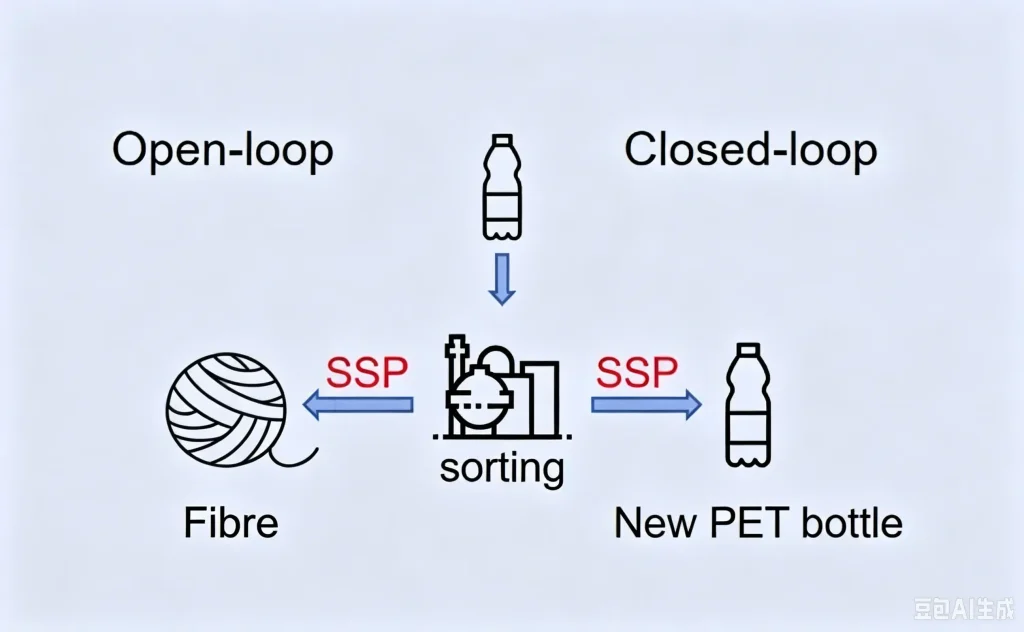
Open-loop vs. Closed-loop: Two pathways for PET recycling

Recycled PET can take one of two routes:

          · Open-loop recycling (“bottle-to-fibre”): Flakes are processed into fibres, filling wadding, strapping, and more. This route has lower costs, but the final products are no longer food-contact compliant.

          · Closed-loop recycling (“bottle-to-bottle”): Flakes undergo deep purification and viscosity increase to restore food-grade quality, turning them back into new bottles. This path offers higher added value but demands far more rigorous processing and must pass food-contact safety certifications.

PET recycling

💡 Key Takeaway: Bottle-to-bottle recycling delivers higher added value and is the preferred route for sustainable packaging.

The core technology: Solid-State Polycondensation (SSP)

Whether for open-loop or closed-loop, PET inevitably degrades during initial processing and recycling, causing molecular weight to drop. To make recycled PET (rPET) suitable for remanufacturing, its molecular weight must be raised.

This critical step is called solid-state polycondensation (SSP). In simple terms, PET flakes or pellets are heated to a temperature above the glass transition temperature (Tg ≈ 65–85°C) but below the melting point (≈265°C). This allows molecular chains to reconnect and lengthen, increasing intrinsic viscosity (IV) and melt strength.

From pellets to fibres: The art of spinning

Once we have rPET chips with the right molecular weight, the next step is melt spinning to produce fibres. PET melt is extruded through a spinneret and cooled and solidified under the pull of a high-speed winder. Different winding speeds determine the fibre type:

          · Low-speed spinning (~1,000–3,000 m/min): Produces Partially Oriented Yarn (POY), requiring subsequent drawing.

          · High-speed spinning (5,000–6,000 m/min+): Produces Fully Oriented Yarn (FOY), ready-to-use as-spun.

          · Ultra-high speed (over 7,000 m/min): The industrial limit, demanding extreme winding-head technology.

Fibres made from recycled PET have a wide range of uses – short fibres blended with cotton for T-shirts, continuous filaments for sportswear, and even high-strength industrial yarns.

The Environmental Balance Sheet

The environmental benefits of PET recycling are tangible:

PET recycling

Recycled PET uses only about one-eighth of the energy of virgin PET. And that’s not counting the savings in petroleum, landfill pressure, and carbon emissions. This clear environmental accounting is the core driver behind the rising global PET recycling rate.

Not every bottle is suited for clothing

Bottle-to-bottle (closed-loop) and bottle-to-fibre (open-loop) have different feedstock requirements:

          · Clear bottles: Typically prioritised for closed-loop recycling to make new food-grade bottles, maximizing value.

          · Colored/mixed bottles: Due to color limitations, they are better suited for open-loop recycling, downgraded into fibres, strapping, and similar products.

So, when you see a sports T-shirt made from “recycled polyester,” it’s very likely that it came from those less-transparent mixed-colour bottles.

Our perspective: driving the circular economy

As a plastic bottle manufacturer, we are not just a producer – we are an active participant in the circular economy. We fully recognise that bottle-to-bottle (closed-loop) is the ideal goal, but it comes with high technical hurdles and costs.

Bottle-to-fibre (open-loop), on the other hand, is an efficient and realistic solution. A T-shirt made from recycled PET consumes about 5–6 standard 500ml water bottles.

We are committed to producing high-quality PET bottles while keeping environmental responsibility in mind – which is why we also use post-consumer recycled (PCR) materials in our production. If you have any needs related to sustainable plastic packaging, feel free to contact us anytime.

发表回复

您的邮箱地址不会被公开。 必填项已用 * 标注